It’s easy to think that the dilemmas faced by art educators today are new ones – but actually discussions about what good art education looks like are remarkably consistent and go back a very long way – certainly to the Victorian period when an Art and Design curriculum was first seriously discussed by government. That, perhaps, is one thing that has changed. Whereas the subject of art is now often treated as a ‘periphery’ subject (in the words of a headteacher local to me), in the 1800’s it was very much at the centre of government concerns about education – they even set up a committee to look into it. It was called the Select Committee on Arts and Manufacturers, it met in 1835/36 and it was,
“…… appointed to enquire into the best means of extending a Knowledge of the Arts, and of the principles of design among the people of the country; also to enquire into the constitution, management and effects of institutions connected with the Arts…” (King, A. (1964). George Godwin and the Art Union of London 1837-1911. Victorian Studies, 8(2), 101-130.)
It’s fascinating to read about the committee and the following books give excellent summaries:
- Macdonald, S. (2004). The history and philosophy of art education. James Clarke & Co..
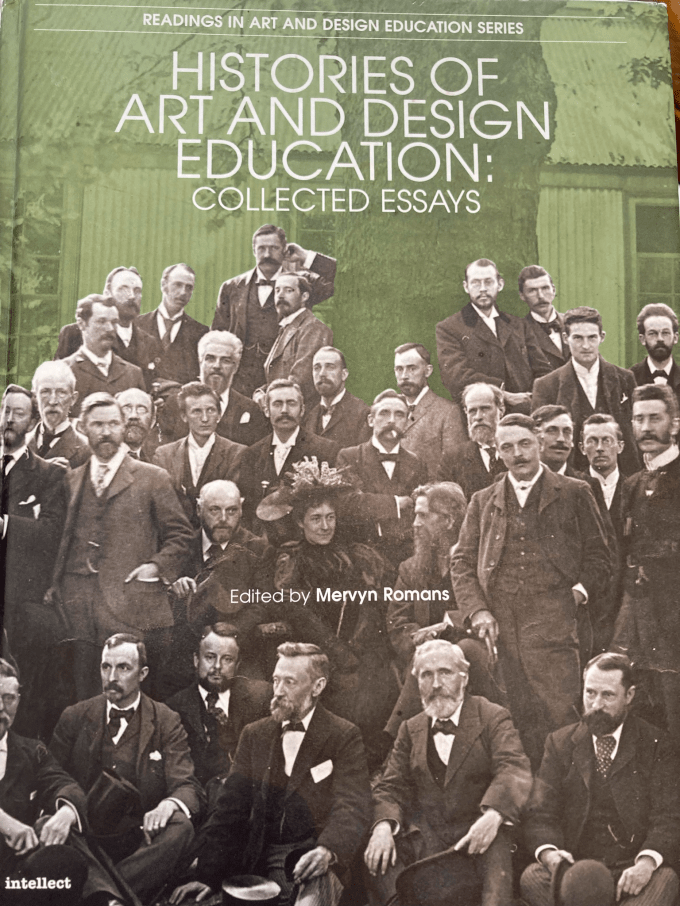
- Romans, M. (Ed.). (2005). Histories of art and design education: collected essays. Intellect Books.
- Borzello, F. (2014). Civilising Caliban: the misuse of art 1875–1980. Faber & Faber.
I’m going to give a bit of background about what transpired following the select committee recommendations and will end will some reflections about how that relates to where we are are today with regards to debates about curriculum design in art.
The experts who offered their input expressed concerns that English designers were less skilled than those from France and Germany and that French designs were particularly superior, with British companies hiring French designers as a result. One opinion expressed at the committee was that the French people as a whole were better educated and that their lower classes were more appreciative of the arts. I’ll perhaps discuss the details of this another time but, for the purposes of this discussion, the outcomes of the committee policy wise were towards better training but also the aim of fostering appreciation of art in the lower classes by making it more accessible:
- The establishment of a school of design in London
- The assistance of provincial design schools with the provision of grants
- A commitment to forming Museums and galleries in provincial towns (that’s where your local museum most likely came from).
- Sculpture and Painting would be used to embellish public buildings.
- The Board of trade was commissioned to oversee implementation
With a new school of design in London and the encouragement of provincial art and design schools too (The names of these institutions changed several times – sometimes Design Schools, sometimes Art Schools, sometimes Art & Design Schools! See John Swift’s chapter on Birmingham and its Art School in Mervyn Romans’ book) attention was also turned to what and how to teach in those institutions. As the French and the Germans were considered superior in design skills the board of trade were interested to find out the approaches taken in each nation.
William Dyce was sent to inquire. MacDonald writes about him in chapter 5 of his book. Dyce had quite fixed ideas about both art and education. He believed that every person should be trained only for the class of society in which God had preordained them to serve, and he regarded art as a science. In France he observed that a distinction between high and low art was not maintained and that students did not decide on ‘art’ or ‘design’ until they had completed a basic course in drawing and painting. Life drawing was an essential part of the system and students painted freely from nature before studying ornament. In Germany, where there was actually a variety of approaches, he liked the Bavarian system of gewerbeschulen where drawing (with an emphasis on outline drawing) was taught alongside french, geography, natural philosophy and chemistry. The best pupils went on to study engineering, architecture etc.
Dyce’s system – 7 stages
Returning from his investigations Dyce proposed his own system with an emphasis on drawing. It had seven stages that students were required to master before moving onto the next.
- Drawing straight lines, Geometric figures and curves on grids
- Copying pictures of shaded objects
- Modelling from casts
- Drawing from the round
- Colour
- Copying elements of the figure
- Instruction in the history and principles of design.
Dyce was made an inspector of the provincial schools by the board of trade – tasked with ensuring that his 7 stage curriculum (referred to as the ‘Somerset House’ system), was implemented properly.
The Inspector from Hell!
George Wallis (see MacDonald Chapter 4 pp.90-95) was a master (teacher / tutor) at Manchester and later head of school at Birmingham. Wallis was trained by Dyce but disagreed with his approach. At Manchester he reduced the amount of time spent on the elementary drawing exercises and introduced a design class. He gave a lecture where he demonstrated a design principle and students had to produce their own original design illustrating the same principle for the next week. He allowed students to draw and paint with a variety of materials and never allowed an exact copy.
In 1845 Charles Wilson (Dyce’s successor) sent written instructions to Wallis that his design class should be abolished and that the ‘Somerset House’ system be re-established. Wallis ignored the instruction. But then, when threats to withdraw finances were made, Wallis resigned – later taking up the post at Birmingham, where thanks to the support of the local guilds, the Art school was less reliant on government funding and could ignore financial threats (underestimate Brummies at your peril!).
Sir Henry Cole
You’ve probably heard of Sir Henry Cole. He campaigned on everything from railway expansion to the establishment of the Penny Post and, lesser known, the reform of art and design education. He was largely responsible, with Prince Albert, for the creation of the Great Exhibition in 1851, and as a founding father of the South Kensington area of museums, he became the first director of the Victoria & Albert Museum.
Cole also became the first General Superintendent of the Department of Practical Art and an inspector with remarkable zeal. He famously said that,
“Accuracy in addition and straight lines are a national want and through the Department the public seek to obtain State help in the production of them” Henry Cole (see MacDonald p.228)
The National Course of Instruction
Cole thought that Dyce’s seven stages were not enough and he created his own curriculum for the schools of art & design. Sometimes called the twenty-three stages (23!!), or the South Kensington System, it was organised in stages influenced by the utilitarian ideas of Jeremy Bentham. Bentham was a philosopher, an economist, a social reformer who was waaay ahead of his time on many things (for example gender equality, the decriminalisation of homosexuality, promoter of animal rights, a minimum wage – if you’ve read any Foucault you’ll know about his prison design, the Panopticon – anyway, I digress! Just saying – he’s an interesting man). Utilitarianism is a philosophy that sees the value of actions as judged by their outcomes or consequences. The aim of utilitarianism is to attain the maximum positive outcomes for the happiness of the most people. As MacDonald explains in his chapter on Cole’s system, Cole liked the idea of utility and consequence but perhaps was less enamoured by the idea of happiness. MacDonald cites him as liking the phrase ‘the Benthamites had very good hearts, but wanted intellect’ (p.228).
Cole’s interpretation of Bentham’s ideas concerned the idea that each task undertaken by students should have a clear ‘use’ or outcome which was to help students progress from simple to complex in the area of design. In discipline terms, he believed drawing to precede painting, which in turn preceded modelling and design. Elementary stages had to be passed through before progression was allowed. Cole so believed in the worth of his system that he published it for wider circulation so that it could be taken up in day schools where pupils followed the elementary stages (drawing lines and shapes, practicing tonal drawing etc.).
What did people make of Cole’s very considered curriculum? Well, he possibly features as an un-named government inspector to the school Marlborough House in Charles Dicken’s Hard Times. MacDonald points to work done by Collins, Fielding and others on Dicken’s original manuscript where the name Cole appears. In the passage in Hard Times the inspector (a seedy comical character) lectures the children on taste, forbidding them to paint foreign birds in their paintings and instructing them to use mathematical figures which are susceptible of proof and demonstration’. If Cole was the inspiration, as it appears he was, then Dickens at least saw him as just a bit ridiculous.
‘Wow’ drawings
The longest-lived part of Cole’s system was the National Competition, through which students who were advanced in their study of the 23 steps submitted drawings for prizes. Prize drawings might have taken students anything up to three years to complete. MacDonald (p.194) includes this account by George Moore of his experience as a student,
‘I shall never forget the scenes I witnessed there. Having made choice of a cast, the student proceeded to measure the number of heads; he then measured the cast in every direction, and ascertained by means of a plumb-line exactly where the lines fell. It was more like land-surveying than drawing, and to accomplish this portion of his task took generally a fortnight, working six hours a week. He then placed a sheet of tissue paper upon his drawing, leaving only one small part uncovered, and having reduced his chalk pencil to the finest possible point he proceeded to lay in a set of extremely fine lines elaborately stippled, every black spot being carefully picked out with bread. With a patience truly sublime in its folly, accomplishing, if he were truly industrious, about an inch square in the course of an evening……. After three month’s work a student began to be noticed; at the end of four he became an important personage. I remember one who had contrived to spend six months on his drawing. He was a sort of demigod, and we used to watch him, anxious and alarmed lest he might not have the genius to devote another month to it, and our enthusiasm knew no bounds when we learned that, a week before the drawing had to be sent in, he had taken his drawing home and spent three whole days stippling it and picking out the black spots with bread.
The poor drawing had neither character nor consistency; it looked like nothing under the sun, except a drawing done at Kensington – a flat, foolish thing, but very soft and smooth.’
If Dickens thought Cole’s ideas were ridiculous, this student concludes that the outcomes are foolish (hardly living up to the utilitarian ideal of being useful).
The moral of the story?
An important thing to say about all of the above is that though the motivations of art (education) reforms during this period are complex (I’ll probably return to them in another blog post) there are, it is mostly possible to argue, always good intentions involved. For example, Cole’s passion for extending art education to children in day schools, or his eagerness to give as many people as possible access to beautiful things through his magazines, exhibitions and museums. He’s certainly not a ‘baddie’. I always prefer to think of negative outcomes as unintentional rather than designed – that might just be a naive outlook (and suggests that I’d struggle to join Bentham as truly utilitarian). However, there are certain things to note. The Kensington System (and the Somerset House System before it) was very much based on the idea of delaying students’ creative work until a time of mastery had been reached. Steps 1-21 were about copying flat images, drawing or modelling from casts etc. The vast majority of students never got to steps 22 and 23. Though it might be possible to argue that the 23 steps led somewhere, as Dicken’s caricature and students testimonies like the one above suggest, it was a tedious process, slightly ridiculous at times and took a very long time. What Cole did, in taking his inspiration from Utilitarianism, was poorly understand and then misapply the ideas he claimed to follow. Where was the maximum happiness that Bentham encouraged?
The same criticism might be levelled at some of what is taking place in British (art) education today. A lot of people have good intentions and a vision for extending the best and most useful form of art education to as many children and young people as possible – often drawing on ideas from big thinkers in education such as E.D.Hirsch (who theoretically follows something called intentionalism) and Michael Young (who is a Social Realist). I’ll talk about some of their ideas in another post because there’s a lot that is good there. However, often those big ideas and the philosophies behind them are poorly understood, misapplied and significantly end up harking back to what is understood to be “traditional” approaches to drawing – which is a problem. Why? Because where does our collective understanding of what traditional drawing is come from? … Victorian art education!
The Kensington System, thanks to the huge reach of British influence in the world during the Victorian era, was one of Britain’s many gifts to the world at this time. Like many of Britain’s gifts to the world it is a mixed bag – promoting art education (yay!) but doing so in a needlessly formulaic way and establishing a kind of international baseline for what art education was expected to look like. As a few of the chapters in Mervyn Romans’ book note, the principles of the Kensington System were also made available in print to those who could not afford ‘proper’ drawing lessons. Drawing manuals from the 1800’s onwards followed a very similar simple to complex utilitarian approach and many many of the steps they included remain part of formal and amateur art education today. These activities on their own are not bad things but equally they do not represent the best that the history of art education has to offer, just the most organised. Importantly as a route to greater knowledge and skill and good design in art they were very strongly rejected by the art educators of the early twentieth century and for good reason.
In the late 1890’s it was Germany who sent inspectors to the UK to look at what was happening in Britain’s art schools prompted by concern that British designers were proving superior to the Germans. But it was not the Kensington system that they were interested in – it was what was going on in institutions such as Birmingham School of Art and Design, where George Wallis, ignoring the threats of government inspectors was pursuing his applied pedagogy – not waiting for students to gain the skills first through simply copying, but demonstrating principles and then giving them plenty of hands-on experience in creating their own designs. The Arts and Crafts movement was influential in several British design schools at that time, not just Birmingham – following the ideas of William Morris, John Ruskin etc.. They still promoted drawing but also aesthetic appreciation, applied learning on live projects and connection with nature (not just copies of nature). What the German inspectors saw at these institutions became the foundation for reforms in German arts schools and ultimately inspired Walter Gropius in his ideas for the Bauhaus (and you likely know the rest of the story there…). These innovations were not the result of some mid-century progressive hippy thinking (as knowledge-rich aficionados might suppose) but grew from ideas at the turn of the century about what the characteristics of good design were.
Whenever I see students in school spending hours completing tonal drawings from a gridded up photograph, (which I see in almost every school I visit at the moment – it seems, for some, to be a fail safe way to high attainment at GCSE or A Level) I wonder what it is for, what its utility is, and I’m reminded of the description of the prize drawing given by George Moore above: “The poor drawing had neither character nor consistency; it looked like nothing under the sun, except a drawing done at Kensington – a flat, foolish thing, but very soft and smooth” – which had no valuable purpose and did not lead to happiness! It feels like somewhere along the way people with really good intentions have missed the point. Breaking art knowledge down into small steps and progressing through them one by one towards an imagined point of mastery leads to a dead end that eventually it is necessary to reverse out of. That’s what British art educators learnt in the 1800’s, but not before we’d exported the Kensington system to the world and established a ‘tradition’ that it has been hard to shake off ever since.
With thanks
There was no time to think historically when I trained to teach art but several years later I had the privilege of studying the Histories of Art and Design Education module with Mervyn Romans at Margaret Street. I wish it could be a compulsory part of art initial teacher training – maybe one day. Thanks Mervyn – you are missed.

 Loving Art Education