I am not completely sure that Arthur Efland was the very first to write about the ‘School Art’ style but his is the name that I have most often heard mentioned as the originator of the term. The connection to Efland stems from his 1976 paper ‘The School Art Style: A Functional Analysis’ . As art education journal articles go (remembering that, as much as I might love the subject of art education, it is still a niche field) this one is a ‘classic’ – Google Scholar suggests it has been cited close to 480 times and it is one of Studies in Art Education’s top ten most cited papers of the last three years – so it is still clearly on the radar.
The trouble with ‘classics’ is that we can think we know what they are about and they can develop a commonly understood relevance but not many of us take the time to actually read them. Where Efland is concerned that is a shame because there are some important points that can be missed as a result.
Much like the Victorian art student commenting that his peers’ work looked like nothing under the sun except a drawing done at Kensington’ (see previous blog post) Efland states that ‘What is so amazing about school art is that it doesn’t exist anywhere else except in schools, and it exists in schools around the world’ (p.38). The implicit suggestion appears to be that this is a bad thing. Efland continues,
‘… the school art style does not seem to be a pedagogical tool for teaching children about art in the world beyond the school, though this is its manifest function, to be sure… there is little resemblance or relation between what professional artists do and what children are asked to do’. (p.39)
Here, as with the Victorian “Kensington’ drawing, there is a value judgement made that the art work produced in the institutional context is not ‘real’ art – but some kind of distorted mutation of art only found in the institution. It is the idea of not being authentically real that is picked up by many who reference Efland’s paper (Clark & Zimmerman 1978; Day & Biblasio 1983; Greer 1984; Hamblem 1985 & 1987; Smith 1989; Jeffers & Path 1996; Anderson & Milbrandt 1998; Gude 2013) to make a pedagogical point that for art education to be better, it’s processes and products need to be closer in kind to ‘real’ art. This might appear to be the point that Efland is making. Or is he?
I’m playing devil’s advocate a bit, but, such an interpretation relies on the assumption that there is an objectively definable, unchanging, homogenous thing called Art (Craft and Design) and also that there is an objectively definable, unchanging, homogenous thing (or style) called ‘School Art’, whereas both change and are diverse. An interesting thing to note is the phase of education that Efland’s paper addresses. If you’ve not read his paper before I wonder what phase of education you presume he is commenting on? He is actually writing about art in Elementary schools (5-11 years) rather than secondary schooling. And I wonder in what ways you presume he is critical of art education in the elementary school context? He notes that primary art education is anti-intellectual, has little critical or historical input, is anti-copying, favours “looseness” rather than “tightness”. This is far from the practice resisted by more recent authors critical of the ‘School Art’ style who tend to call for less tightness, less copying, more making (real) art.
Taking Efland’s paper together with the criticisms levelled against the Kensington drawings and debates about school art more recently (a touchpoint in England being the 2004 NFER publication School Art: What’s in it?’ which surprisingly didn’t reference Efland) it is possible to conclude that though art education changes, its lack of authenticity (as ‘real’ art) apparently does not. And this, I think is a more important point to take from Efland’s paper – an application that is not pedagogical but sociological. Efland’s actual question, in the paper, is not ‘how can we make School Art more authentic?’ but what can School Art tell us about ‘the structure of social relations or the structure of beliefs that operate within the school?’ (p.39) and what role does art play within those relations?
His observation, in the US in the 1970’s, when the American Dream founded on humanistic, liberal, democratic principles underpinned what public education is about, is that, ‘One of the functions of the school art style is to provide behaviours and products that have the look of humanistic learning’ (p.41 – italics mine). He proposes that art education does this by ensuring that the works produced are unique to the child by having a ‘free and creative’ style. These products, adorning school displays, sent home to parents etc. create the appearance of free, expressive (human) children with agency, power over their own art-making (and consequently their own destiny). Efland’s critique looks beyond the ‘look’, questioning the individual child’s agency and the extent to which their art making can be said to be free or expressive at all. He shows how the art teachers in such contexts are very much in control of the creative process leaving the children with little choice but to create work that looks a certain way to fulfil the humanistic objective (For a much more contemporary investigation of exactly the same phenomenon see Kerry Thomas’ (2019) excellent sociological enquiry into Year 12 art students’ work in Australia – start with her IJADE article and then get hold of the book). He also suggests that the ‘appearance’ of humanistic learning that art gives the school might mask the lack of agency children have more generally across all subjects. Efland’s concern is not so much that School Art does not look like real art but that it claims to be the unique, freely given expression of the child, when really it is not.
I have called this post School Art Part 1 because there is soooo much more to say than can be covered in one post (I haven’t even mentioned, Bourdieu, or Bernstein yet!) and so I will definitely return to this at some point. But there are a few questions that I think arise from Efland’s paper that it is pertinent to raise now, seeing his paper not as as a catalyst to change the curriculum or pedagogical style but to examine the subject sociologically. This means asking,
- If art education’s role in schooling is to give the ‘appearance’ or ‘look’ of something, what ‘appearance’ or ‘look’ is it currently responsible for giving? Has this changed from Efland’s time or is it the same? – this is very different from asking what we would like it to look like!
- If our subject is socially constructed, what ways of thinking and being does it quietly reproduce and what might we find if we scratch below surface appearance?
So, I’ll leave you with those questions – interested to know what you’re thoughts are. Please comment!
My experience talking to art teachers suggests that many of us are very sensitive when it comes to the idea of School Art. I’ve met none that proudly claim to promote a School Art style in their classroom and plenty that claim that their department is definitely NOT of the School Art type. And yet there always exists a caricature of art lessons (that I won’t go into as almost all schools I visit adhere to it to some extent or another). The highest accolade that can be given it seems is still that ‘the work is so varied’ and that there is no ‘house style’ – but again, almost all schools I visit have a certain approach that produces a certain kind of outcome. THIS IS NOT A BAD THING. All great artists are known for their style – why shouldn’t great art teachers be too?
Anxiety about producing tired and predictable outcomes is understandable, just as an artist is eager to avoid cliche, and over-used tropes so is an art teacher. It is important for the vibrancy of teaching and for the personal satisfaction of the teacher that it feels fresh. That’s where Efland’s paper is important for another often overlooked reason – he very clearly states that blaming the art teacher for School Art is ‘a little like blaming the crime on the victim’ (p.40). Just as school art students are not as unique and free as they might appear to be (the art teacher surreptitiously pulling all the strings) – neither are art teachers.
Who is pulling your strings? When thinking about that question – sociologically speaking there is no situation in which there are no strings! At any given time the strings may be multiple! Hanawalt’s (2018) paper offers a contemporary reworking of Efland’s paper, examining the social relations (and strings) of contemporary schooling and the beginning art-teacher’s place within it – there is much that is relevant for a UK context for new and experienced teachers alike.
So, further musings about art education from a sociological position generally, and School Art specifcally, to follow – but my next post will jump back to the 1950’s and a rather heated art education conference that took place then (making our brilliant NSEAD get togethers look very tame!). Watch this space.
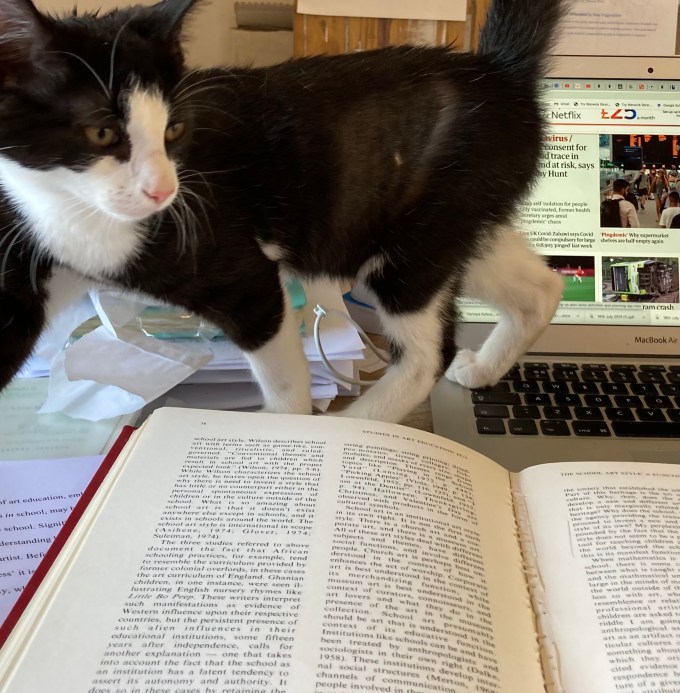
Oh and I didn’t really know what to put as a picture, then my kitten popped up to have a sniff at Studies in Art Education vols,1995-17 which includes Efland’s paper – and who doesn’t like a kitten? (rhetorical question!) – so she gets a feature.
Efland, A. (1976) ‘The School Art Style: A functional analysis’. Studies in Art Education 17(2) pp.37-44.
Clark, G.A. & Zimmerman, E. (1978) A Walk in the Right Direction: A Model for Visual Arts Education, Studies in Art Education, 19:2, 34-49, DOI: 10.1080/00393541.1978.11649961
Day, M. & DiBlasio, M. (1983) Contributions of Research to the Teaching of Art, Studies in Art Education, 24:3, 169-176, DOI: 10.1080/00393541.1983.11650339
Greer, W.D. (1984) Discipline-Based Art Education: Approaching Art as a Subject of Study, Studies in Art Education, 25:4, 212-218, DOI: 10.1080/00393541.1984.11650379
Hamblen, K.A. (1985) The Issue of Technocratic Rationality in Discipline-Based Art Education, Studies in Art Education, 27:1, 43-46, DOI: 10.1080/00393541.1985.11650509
Hamblen, K.A. (1987) What General Education Can Tell Us About Evaluation in Art, Studies in Art Education, 28:4, 246-250, DOI: 10.1080/00393541.1987.11650575
Smith, P. (1989) ‘Reflection on “The School Arts Style”. Visual Arts Research, pp.95-100
Jeffers, C.S. & Parth, P. (1996). Relating Controversial Contemporary Art and School Art: A Problem-Position. Studies in Art Education: Vol. 38, No. 1, pp. 21-33.
Anderson, T. & Milbrandt, M. (1998) ‘Authentic instruction in art: Why and how to dump the school art style’. Visual Arts Research, pp.13-20
Downing, D. and Watson, R., (2004). School Art: What’s in It?: Exploring Visual Arts in Secondary Schools. London: National Foundation for Educational Research.
Olivia Gude (2013) New School Art Styles: ‘The Project of Art Education’, Art Education, 66:1, 6-15,
Buffington, M.L. (2014). ‘Power Play: Rethinking Roles in the Art Classroom’. Art Education: Vol. 67, No. 4, pp. 6-12.
Hanawalt, C. (2018). ‘School Art in an Era of Accountability and Compliance: New Art Teachers and the Complex Relations of Public Schools’. Studies in Art Education: Vol. 59, No. 2, pp. 90-105.
Thomas, K., (2019). The paradox of creativity in art education: Bourdieu and socio-cultural practice. Springer.

 Loving Art Education